Cricbet99 Win ID vs Betway India — Complete 2026 Comparison

Betway is the disciplined professional of online bookmaking — licensed, measured, no gimmicks. Cricbet99 is a betting exchange reached through WhatsApp IDs. Between them sits the clearest version of the classic choice: regulated simplicity versus market mechanics. If you have ever wondered why the same India–Australia match shows 1.85 on one screen and 1.92 on the other, this page is the long answer.
This comparison respects both sides. Betway does the bookmaker model about as well as it can be done; the question is whether the model itself gives a cricket bettor enough. A fixed-odds book sells you one thing: a price it has set, which you can accept or ignore. An exchange sells you a market: prices set by other players, which you can accept, ignore, or oppose by laying. Everything else — KYC, wallets, bonuses, cash-out buttons — follows from that one structural fact.
We compare the two the way a player meets them, in order: opening the account, finding the match, pricing the bet, managing it in-play, and getting paid. Each stage gets both platforms’ honest version. The feature table condenses it, the category scores summarise it, and the verdict names who should pick which — including the players who should genuinely stay with Betway. Claims about the exchange side can be tested with a small ID in one evening; claims about Betway are the generic, verifiable facts of how licensed sportsbooks work, not a reading of its private terms.
One framing note before the details. Neither platform is "fake" relative to the other, and neither is cheating you. A licensed bookmaker charges for its product through the margin inside its odds; an exchange charges through a visible commission on net winnings. Once that frame is in place, every row of the table below becomes predictable, and most readers know their own answer by the third section.
A last word on who this is written for: adults, 18 and over, betting money they can afford to lose. Both platforms carry real risk, and the better mechanics of an exchange do not turn a losing bettor into a winning one — they make the same skill worth more. If limits are a problem for you, the responsible-gambling page matters more than anything that follows.
Feature-by-feature
| Feature | Cricbet99 Win ID | Betway India |
|---|---|---|
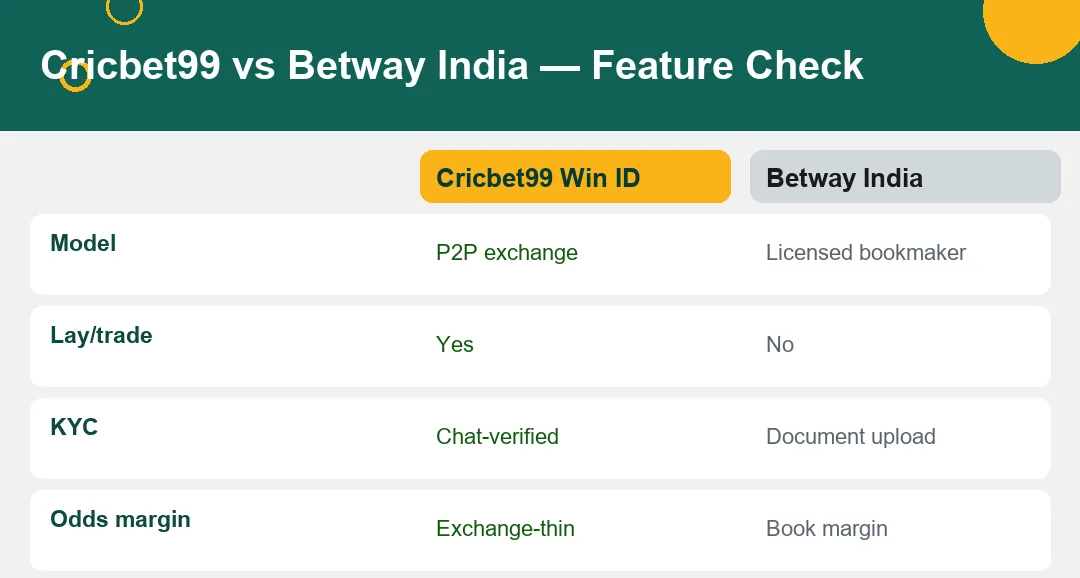
| Model | P2P exchange | Licensed bookmaker |
| Lay / trading | Yes — every market | No |
| Cricket sessions/fancy | Full live board | Mainline + limited props |
| KYC | None — chat verified | Document verification |
| Odds margin | Commission ~2-3% on wins | Book margin in prices |
| Registration | WhatsApp, quick | Form + verification |
| Deposits | UPI via agent, chat-confirmed | Wallet gateways, card/UPI/e-wallet |
| Withdrawals | Same-day UPI via chat | Wallet queue after KYC |
| In-play exit | Lay out at your price | Cash-out button, house price |
| Brand assurance | Panel brand + chat records | International licensing |
| Promotions | Chat-agreed, simple terms | Structured, conservative, rollover-based |
| Support | 24/7 human WhatsApp, Hindi/English | Live chat + email, scripted tiers |
Category scores at a glance
Before the detail, here is how the two platforms score in our own testing across the eight categories a cricket bettor actually cares about. These are our assessments from a player’s seat, marked out of ten, not anyone’s official figures — and the chart under this section shows the same numbers visually.
| Category | Cricbet99 Win ID | Betway India | Why |
|---|---|---|---|
| Account access | 9 | 6 | Chat ID in minutes vs form, email and document checks |
| Cricket market depth | 10 | 5 | Live session and fancy board vs mainline plus a few props |
| Odds value | 9 | 6 | Commission on wins vs margin on every price |
| In-play control | 10 | 6 | Lay at any price vs a single cash-out offer |
| Payout speed | 9 | 6 | Same-day UPI vs KYC-gated wallet queue |
| Support | 9 | 7 | One human thread vs tiered live chat |
| Institutional assurance | 6 | 10 | Licensing and segregated funds are Betway’s home ground |
| Promotions | 7 | 7 | Small and plain vs structured with rollover |
Two things stand out. First, the categories where Betway leads are the ones about the institution, and the categories where Cricbet99 leads are the ones about the bet. Second, the gaps are not uniform: assurance is a four-point swing towards Betway, market depth is a five-point swing towards the exchange. Your own weighting of those two rows is basically the whole decision, and the rest of this page exists to help you weight them honestly.

Reading the feature table properly
Feature tables flatter whoever wrote them, so here is how to read ours without being led. The rows fall into three groups. The model rows — exchange versus bookmaker, lay versus no lay, commission versus margin — are structural and will not change with a promotion or a new app version. The process rows — registration, KYC, deposits, withdrawals — describe the path your money walks, and they are where daily frustration or daily ease actually lives. The service rows — support, promotions, assurance — are the ones most reviews argue about and the ones least likely to matter on a Tuesday night.
The row most people misread is KYC. "None — chat verified" is not a boast that Cricbet99 skips checks; it means verification happens through the conversation and the bet log rather than through document uploads. "Document verification" on Betway’s side is not an insult either; it is what a licensed operator must do and it buys you a regulated custody structure. Same row, two legitimate philosophies, and you should know which one you are buying.
The other row to weigh carefully is in-play exit. A cash-out button and a lay button both let you leave a bet early, but only one of them lets you set the price. That single word — your price versus their price — is the difference between a customer and a trader, and it shows up again in the worked example a few sections down.
Read the table with those three groups in mind and it stops being a scorecard and becomes a map: model rows tell you what the platform is, process rows tell you what it costs in time, and service rows tell you how it feels.
The model gap, with real numbers
Betway quotes you 1.85 on India to beat Australia; the exchange shows 1.92 to back and 1.94 to lay on the same outcome. Those seven points are the bookmaker margin — Betway’s revenue, which it earns honestly and openly by pricing both sides of every market a little short. The exchange replaces that with a small commission on net winnings only, typically two to three percent, charged after the market settles.
Put ₹1,000 on India at both prices and let India win. Betway returns ₹1,850, a profit of ₹850. The exchange returns ₹1,920, a profit of ₹920, less 2.5% commission on the win — ₹23 — for a net profit of ₹897. Same match, same stake, same result, ₹47 more in your pocket. If India loses, both bets lose exactly ₹1,000: the exchange charges nothing on a losing market, which is why "commission on net winnings" is a cheaper fee than it sounds.
Now scale it. A regular who places sixty such bets across an IPL season at roughly even money, winning half, gives up around ₹1,400 more to the bookmaker margin than to exchange commission — before considering that the exchange price is usually the better one to begin with. The odds guide walks through why peer-set prices sit closer to true probability than a house-set book; the short version is that nobody on an exchange has to build their salary into the number.
Getting in: two registration paths, step by step
The account-opening experience is where the two philosophies first touch your life, so here is each path in the order you would actually walk it.
Betway India, the licensed route. Step one: open the site or install the app — on Android that means an APK from Betway’s own site, since Play Store policy keeps real-money betting out. Step two: fill the registration form — name, date of birth, email, mobile, address, password. Step three: verify your email and phone. Step four: deposit through a gateway. Step five, usually triggered at first withdrawal: upload ID proof and address proof and wait for verification. It is orderly, and every step has a reason under the licence, but a first-time player typically counts a day or two between "I want to bet" and "I have withdrawn a win".
Cricbet99 Win ID, the chat route. Step one: message the official WhatsApp number. Step two: state that you want a new ID; the agent confirms the deposit method and any current offer in the same chat. Step three: send the UPI transfer and the screenshot. Step four: receive your panel login — username, password, link — as a message you can scroll back to forever. Step five: log in, change the password, place a ₹100 test bet to learn the ladder. The full walkthrough with screenshots is in the ID kaise banaye guide; most players finish inside ten minutes.
The honest caveat cuts both ways. The chat route asks you to trust a brand and its record-keeping rather than a regulator, which is why we tell everyone to use only the official number and to keep the thread. The licensed route asks you to hand over identity documents to an offshore company, which privacy-minded players weigh just as seriously. Neither is free of trade-offs; the table simply shows which trade-off each platform has chosen.
Market depth: where session players decide fast
The deal-breaker for cricket specialists is coverage. Betway’s per-match cricket offering is respectable by bookmaker standards — match winner, top batter, top bowler, innings totals, a handful of player props on big fixtures — and its prices on those markets are competitive within the sportsbook world. But it is a fraction of an exchange fancy board. No over-by-over run brackets, no next-wicket ladders, no live "runs in this session" line that re-quotes every delivery.
On the Cricbet99 panel, a single IPL night carries dozens of live markets: 6-over runs, 10-over runs, 15-over runs, batter milestone lines, fall-of-wicket brackets, partnership totals, and the match odds ladder moving with every ball. The session guide explains how to read the lines; the fancy guide covers the rest of the board. If those words already mean something to your betting, the comparison ended before this page loaded.
The reason is structural, not laziness on Betway’s part. A bookmaker must price and risk-manage every market it offers, so it offers the ones it can price safely. An exchange only hosts the market; the players price it, and depth appears wherever enough of them want to trade. That is why the exchange board grows with the match while the sportsbook tab is set before the toss.
The image beside this section shows the practical result: the same over of the same match, one screen with two markets, the other with a live board. Nobody who has bet sessions goes back to the two-market screen for cricket, and nobody who has never bet sessions understands the fuss until they watch a powerplay with the board open.

In-play control: cash-out button versus lay button
Both platforms let you leave a bet before the match ends, and this is where the customer-versus-trader distinction becomes money. Work one position through both.
You back India at 2.00 for ₹1,000 before the toss. India bat first, post 210, and Australia lose two wickets in the powerplay. India are now trading at 1.50. On Betway, you tap cash-out and the button shows you an offer — the bookmaker’s calculation of your position’s value, minus its margin for the convenience. A fair value for a ₹1,000 bet at 2.00 now priced at 1.50 is about ₹1,333; a typical cash-out offer lands somewhat below that, because the house prices the exit the same way it prices the entry. You take it or you do not; there is no third choice.
On the exchange you lay India at 1.50 for ₹1,333. Now if India win, your back pays ₹1,000 profit and your lay loses ₹667: net +₹333. If Australia chase it, your back loses ₹1,000 and your lay wins ₹1,333: net +₹333. You have locked ₹333 whichever way the match goes, at a price the market set rather than one the house offered — and if you think 1.50 is too short, you can wait for 1.60 or lay only half. The in-play guide covers the timing; the matched versus unmatched guide covers what happens if the market moves before your lay fills.
The money path: deposits and withdrawals on both sides
Comparisons usually stop at features; the money path is where platforms diverge in daily life. On the Cricbet99 side the whole journey lives in one WhatsApp thread. You send UPI to the account the agent confirms, attach the screenshot, and the balance appears on the panel within minutes at one-to-one. Winnings sit as settled balance. A withdrawal is a message — amount and UPI ID — verified against the bet log and paid the same day in normal hours. The deposit guide and withdrawal guide show each stage with screenshots.
On the Betway side deposits route through payment gateways into the site wallet — cards, UPI, net banking or e-wallets depending on what is live that month. It is smooth in the common case and occasionally bounced by gateway availability. Withdrawals trigger the licensed machinery: KYC documents on first payout, method-dependent minimums, a processing window measured in working days, and then the wallet-to-bank leg. It works, and thousands of players are paid every week; it is simply a path with more stages, more actors and more places to wait.
The structural reason deserves respect. Betway’s KYC-gated wallet is what its licence requires, and that same requirement is what gives you segregated funds and a complaints route above the operator. The chat-verified flow is what the exchange ID model enables, and its guarantee is a written record you hold rather than a regulator you can appeal to. Neither side is being difficult; they are being what they are.
The speed verdict in the image is therefore not "Betway is slow" — it is that the exchange path has fewer stages, and players who value payout simplicity discover the difference the first time they win meaningfully, which is the worst possible moment for a surprise.
Bonuses and rollover: the arithmetic nobody does
Betway’s promotions are conservative by industry standards, which is a compliment: a welcome offer, occasional free bets around big series, and terms written clearly. The mechanism, though, is the sportsbook norm — a bonus credited to the wallet that must be turned over a set number of times at minimum odds before it becomes withdrawable. Rollover multiples of several times the bonus at odds above a floor are the industry pattern; check the current terms yourself before assuming any figure.
Here is why the multiple matters more than the headline. Suppose a ₹5,000 match bonus carries a five-times rollover at minimum odds of 1.80. You must stake ₹25,000 through markets that each carry roughly six to eight percent margin. The expected cost of pushing ₹25,000 through a 7% margin is about ₹1,750 — the bonus is real, but a third of it is spent earning it, and variance can take the rest before you clear.
The Cricbet99-side offers are smaller and plainer: a welcome boost, weekly refills, referral credit — each quoted in chat with percentage, minimum deposit and turnover, and applied at deposit time. The bonus page keeps the current list. The comparison test is one division: bonus amount divided by required turnover, then multiplied by the fee rate you will pay to churn it. Run it honestly and the modest written offer beats the packaged one more often than marketing suggests.
The stat in the image is that single figure — the effective cost of clearing — and it is the one number a bonus hunter should carry from platform to platform. It does not make Betway’s offers bad; it makes them priced, and a disciplined player who reads terms can still extract value from them. Read the promo code page for how codes are applied on the exchange side.
The Indian context: UPI, IPL nights and the law
Both platforms serve Indian players, but they meet Indian reality differently. Money first: UPI is how India moves cash, and the exchange route uses it natively — a transfer to a confirmed account, a screenshot, done. Betway’s gateway list changes with banking conditions, and a method that worked in March may be unavailable in June; that is not Betway’s fault, but it is your Tuesday night. Keep a second method ready on any platform.
Cricket second. IPL is where the two models are furthest apart, because a two-month tournament of daily T20s is exactly the environment where session and fancy markets outnumber match-winner bets ten to one. The IPL betting guide is written for that season; the sportsbook experience of IPL is essentially sixty match-winner bets with a top-batter flutter attached.
Law third, and honestly. Online betting in India is regulated at the state level: some states prohibit it outright, others are silent, and the position changes. Betway’s international licence does not override a state ban, and neither does an exchange ID. Read the legality guide, know your own state’s position, and take responsibility for it — no platform will do that for you.
- Back
- Betting that something will happen — the only bet a bookmaker sells.
- Lay
- Betting that something will not happen; you become the bookmaker for that bet. Exchange only.
- Margin (overround)
- The amount by which a bookmaker’s prices on all outcomes exceed 100% — its built-in fee.
- Commission
- The exchange’s fee, a small percentage of net winnings on a market, nothing on losses.
- Rollover / wagering
- The number of times a bonus must be staked before it can be withdrawn.
- Session
- A market on runs scored within a defined block of overs — the heart of Indian cricket betting.
Who should honestly choose Betway — and a decision checklist
A fair comparison names its losing cases. Choose Betway over the exchange if: you bet a few times a month on match winners and value a licensed, regulated-feeling app with no learning curve; you specifically want KYC-backed custody and a complaints route above the operator, and accept margin as the price of it; you bet across football, tennis and cricket and want one clean account for all of it; or you know you will never learn the lay side and prefer a cash-out button that cannot be misread. These are real player types, well served there, and pretending otherwise would make every other paragraph on this page less believable.
Choose the Cricbet99 Win ID when cricket depth is the point — sessions, fancy, in-play trading, net pricing — and when you want a service channel that answers at match speed rather than at ticket speed. The overlap case exists too: plenty of players keep a Betway account for weekend football and an exchange ID for serious cricket nights, and the two coexist happily in one betting life — provided it is one bankroll with one limit, which the bankroll guide explains.
Run this checklist before you commit money to either:
- Do I know what a session market is, and do I want to bet one? Yes → exchange. No, and not curious → Betway is fine.
- Would I ever want to exit a bet at a price I chose rather than one offered to me? Yes → exchange.
- Is a regulator I can appeal to worth 6-8% of every price to me? Yes → Betway.
- Do I want to upload identity documents to an offshore operator? No → exchange; yes or indifferent → either.
- Have I read one bonus’s full terms on each side and done the rollover division? Not yet → do it before depositing anywhere.
- Have I set a weekly loss limit I will actually keep? Not yet → set it before reading any further comparison.
For a wider view, the provider rankings place both platforms among the rest of the market, and the Parimatch and 1xBet comparisons cover the other licensed-style books most Betway shoppers also consider.
Verdict
Mechanics and depth: Cricbet99 Win ID. Institutional assurance: Betway. A fair split: casual weekend bettors who value licensing above all pick Betway with clear eyes; active cricket bettors and traders find the exchange model pays for itself within weeks. Test both convictions cheaply — a small Cricbet99 ID beside a Betway account, one match, same bets.
The numbers that decide it are small per bet and large per season. Forty-odd rupees of extra profit on a winning thousand-rupee bet is easy to dismiss; multiplied across a season of sixty bets, plus the positions you locked in with a lay that a cash-out button would have shaved, plus the sessions you could not bet at all on a sportsbook, it becomes the difference between a hobby that costs you and a hobby that occasionally pays. That is the exchange case in one paragraph, and it is a case about arithmetic, not about Betway being a bad operator.
Who should honestly choose the other side: the player for whom the word "licence" is the first thing they want to hear, who bets rarely and mostly on match winners, who wants one account across many sports, and who would rather never see a liability figure. Betway serves that player better than an exchange does, and no amount of session-board enthusiasm changes it. If you are unsure which player you are, the ten-minute experiment — same match, both screens, ₹100 each side — will tell you faster than any verdict paragraph.
Whichever way you go: 18+, money you can afford to lose, a limit set in advance, and the how-it-works page read once before your first real stake on the exchange side.
More head-to-heads live in the guides library, or start from the main Cricbet99 Win ID page. Ready to try the Cricbet99 side of the table? Registration takes two minutes.