How Cricbet99 Exchange Odds Work

Odds are just probability wearing a price tag. Learn the conversion once and every screen on the Cricbet99 exchange becomes readable — the blue and pink columns, the way a price jumps on a wicket, the difference between a market that is fair and one that is quietly charging you. This guide takes the conversion from a formula to a habit, walks through the ladder column by column, shows how a chase reprices ball by ball with real numbers, and finishes with the misreads that cost new players most. Nothing here needs more than school arithmetic.
Decimals = payout, directly

The card above says it in four words, and it really is that plain. A decimal price is your total return per unit staked, stake included. Back 500 at 2.50 and a win returns 1,250 — 750 profit plus your 500 back. Back 500 at 1.25 and a win returns 625, of which only 125 is profit. Nothing to translate, no fractions, no American plus-minus: multiply stake by price and you have the return; subtract the stake and you have the profit.
The habit to build is reading the profit, not the return, because the profit is what the bet is actually offering you for the risk. A price of 1.25 looks comfortable — the market is saying the outcome is very likely — but you are risking 500 to make 125, four units of risk for one of reward. A price of 4.00 risks 500 to make 1,500, one unit for three. Neither is “better”; they are different bets on different probabilities, and the price is simply the exchange rate between them.
| Stake | Price | Return if it wins | Profit | Risk : reward |
|---|---|---|---|---|
| 500 | 1.25 | 625 | 125 | 4 : 1 |
| 500 | 1.80 | 900 | 400 | 1.25 : 1 |
| 500 | 2.50 | 1,250 | 750 | 1 : 1.5 |
| 500 | 4.00 | 2,000 | 1,500 | 1 : 3 |
Price = probability

The second card is the one that changes how you see the screen. Divide 100 by the odds and you get the market’s opinion: 100 ÷ 2.00 = 50% · 100 ÷ 4.00 = 25% · 100 ÷ 1.50 = 66.7%. When India drift from 1.80 to 2.20 after a wicket, the market has just downgraded them from 55.6% to 45.5% — the ladder is a live probability chart drawn in prices instead of percentages.
Once this is automatic, the question you ask of every price changes. Instead of “is 1.80 a good price?” — which has no answer on its own — you ask “do I think India win this more than 55.6% of the time from here?” That is a question you can actually have an opinion on, using the pitch, the batters left, the required rate. If your honest answer is “yes, closer to 65%”, the price is offering you value. If your answer is “about that”, there is no bet, however tempting the number looks. The entire craft of exchange betting sits inside that one reframing.
| Price | Implied probability | What the market is saying |
|---|---|---|
| 1.20 | 83.3% | Heavy favourite — five in six |
| 1.50 | 66.7% | Clear favourite — two in three |
| 2.00 | 50.0% | Coin toss |
| 3.00 | 33.3% | Outsider — one in three |
| 5.00 | 20.0% | Long shot — one in five |
| 10.00 | 10.0% | Needs something unusual |
Reading the back/lay ladder step by step
The ladder is where beginners freeze, so here is a real one, read slowly. A match-odds market on India versus Australia might show something like this in the moments before the toss. Blue is the back side, pink is the lay side, and the amounts are the money waiting to be matched at each price.
| Selection | Back 3 | Back 2 | Best back | Best lay | Lay 2 | Lay 3 |
|---|---|---|---|---|---|---|
| India | 1.88 4,200 | 1.89 6,100 | 1.90 8,500 | 1.91 7,300 | 1.92 5,900 | 1.93 3,800 |
| Australia | 2.06 3,100 | 2.08 4,700 | 2.10 6,200 | 2.12 5,500 | 2.14 4,000 | 2.16 2,900 |
- Find the two centre columns. The best back (blue, 1.90 for India) is the highest price someone is currently willing to lay you. The best lay (pink, 1.91) is the lowest price someone is willing to back at — so it is the price you can lay at. Everything further out is queued money at worse prices.
- Read the spread. 1.90 to 1.91 is a single tick. That is a liquid, healthy market; you can get in and out without giving anything away. If the centre columns showed 1.85 and 2.00, the market is thin and you should either wait or place your own price.
- Read the money. 8,500 waiting at 1.90 means a back of 1,000 matches instantly and the price does not move. A back of 20,000 would eat through 1.90 and start matching at 1.89 and 1.88 — the ladder tells you in advance.
- Check both selections agree. India best back 1.90 (52.6%) and Australia best back 2.10 (47.6%) sum to 100.2%. That near-100 total is the exchange telling you there is no margin hidden in the prices. Do this check once on any new market and you will never be fooled by a padded book again.
- Decide which side of the centre you belong on. Higher on India than 52.6%? Back the blue. Lower? Lay the pink, or back Australia — the two are close to the same bet, differing only in the liability structure the back vs lay guide explains.
Overround vs commission — the number that decides it
Every market has a price of admission; the only question is whether you can see it. A bookmaker builds its fee into the odds. Take a typical fixed-odds cricket line of 1.83 on India and 1.95 on Australia: 54.6% plus 51.3% is 105.9%. The extra 5.9% is the overround, and it is charged inside every price whether your bet wins or loses. Over a season of bets that is a tax on activity, not on success.
The exchange ladder above books to 100.2%, because the prices are set by other bettors competing to be matched rather than by a trader protecting a margin. The fee lives elsewhere — a small commission on net winnings on a market, charged only when you finish that market in profit. Lose the market and you pay nothing beyond the loss.
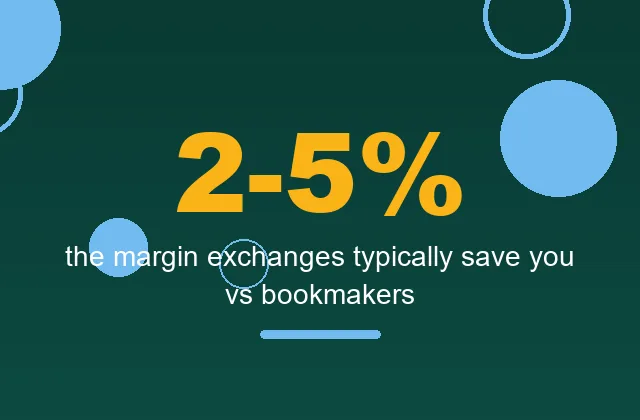
The stat on the card is the one to carry in your head: about six points of overround at a bookmaker against two to three points of commission on wins only. Same bet, same result, but the exchange bettor keeps roughly twice as much of the edge. That gap is why a value bet that is marginal at a bookmaker can be comfortably profitable on an exchange, and why learning to read the ladder pays for itself in the first month.
From price to profit — the three-step habit

The diagram compresses everything above into a routine you run on every market, every time, until it takes about four seconds. The order matters: reading before converting, converting before deciding. Players who skip the middle step end up betting on whether a number “looks big”, which is not a strategy, it is a mood.
- Read the ladder. Blue column = prices you can back at; pink = prices you can lay at. The best offers sit in the centre, one or two ticks apart on liquid markets. Note the money queued at each — it tells you how much you can stake before the price moves.
- Convert to implied probability. The 100-divided-by habit, until it is automatic. Then check the two selections sum close to 100, so you know the market is fair before you trust it.
- Bet only the gaps. Your estimate is not the market’s? That gap is value — back when you are higher, lay when you are lower. No gap, no bet. Most markets, most of the time, offer no gap, and the discipline to close the screen is the whole difference between a bettor and a punter.
The third step is where stakes come in, and it belongs to a different guide. A gap of three or four percentage points is worth a normal unit from your bankroll plan; a gap of one point is usually inside your own estimation error and worth nothing. The habit is not “find a gap, bet big”. It is “find a gap, bet the unit, repeat for a season”.
How prices move with wickets and runs — a chase, ball by ball
Exchange prices move with money and events: team news, the toss, a powerplay over, a dropped catch. But the clearest way to see the mechanism is a single chase. Suppose the chasing side needs 180 from 20 overs in a T20 and started as slight favourites at 1.85. Here is how the price on them might travel, with the implied probability alongside so you can see what each move actually means.
| Over | Score | Need | Price on chasers | Implied | Why it moved |
|---|---|---|---|---|---|
| 10.0 | 85/2 | 95 off 60 | 1.85 | 54% | On par; two set batters |
| 14.0 | 120/3 | 60 off 36 | 1.60 | 62.5% | Rate under control, wickets in hand |
| 14.1 | 122/4 | 58 off 35 | 2.20 | 45.5% | Set batter out — one ball, 17 points |
| 18.0 | 160/5 | 20 off 12 | 1.70 | 58.8% | Two big overs; new batter settled |
| 19.3 | 172/6 | 8 off 3 | 3.00 | 33.3% | Wicket, tail exposed, rate now steep |
Two things stand out. First, runs move the price slowly and wickets move it sharply: four overs of good batting shifted the market eight points, one wicket shifted it seventeen. That asymmetry is the single most important thing to understand about cricket markets, and it is why a set batter’s dismissal is the moment to have a view ready rather than the moment to form one. Second, every price in the table is a probability you can argue with. At 14.1 the market said 45.5%; a bettor who knew the incoming batter was in form and the bowling side had used its best overs might have said 55%, and backed at 2.20. That is what value looks like in practice.
Movement creates the trades covered in the back-vs-lay guide — back at 2.10, lay at 1.60, keep the difference. Fixed bookmaker odds move too, but you can never take the other side of them. The in-play guide turns this table into a routine for live sessions.
Worked example: turning a price move into a locked profit
Here is the arithmetic of one trade, in full, because seeing the numbers once makes the concept permanent. Before the 14th over you backed the chasing side for 1,000 at 2.10, when the market briefly drifted on a tight over. Your position: win 1,100 if they chase it, lose 1,000 if they do not.
By over 18 the price has come in to 1.60. You now lay at 1.60, choosing a lay stake that makes your profit identical whichever way the match ends. The formula is original stake × original price ÷ new price: 1,000 × 2.10 ÷ 1.60 = 1,312.50. Lay 1,312.50 at 1.60 and your liability on that lay is 1,312.50 × 0.60 = 787.50.
- If the chasers win: back bet pays +1,100, lay bet loses −787.50. Net +312.50.
- If the chasers lose: back bet loses −1,000, lay bet pays +1,312.50. Net +312.50.
Either way you have 312.50 locked before the last over is bowled, and commission is charged once on that net figure, not on each leg. Had the price gone the other way — out to 3.00 on a wicket — the same formula would let you lay to cap the loss instead: 1,000 × 2.10 ÷ 3.00 = 700 laid at 3.00, for a locked loss of 300 rather than a possible 1,000. Reading the price as a probability is what tells you when each of those is the right call; the formula is just the plumbing.
Common misreads — and what to do instead
The mistakes below are not beginner-only. Experienced players make most of them on a busy night, which is why they are worth writing down as a checklist rather than trusting to memory.
| Misread | What actually happens | Fix |
|---|---|---|
| Reading the lay price as “the odds” | You quote 1.91 and can only back at 1.90 | Blue is your back price; pink is what you can lay at |
| Treating a short price as “safe” | 1.20 still loses one time in six, with 5:1 risk | Convert to probability, then ask if 83% is right |
| Ignoring the money column | A big stake walks down the ladder to worse prices | Stake within the queued amount or split the bet |
| Chasing a price that just moved | You bet on the last ball, not the next fifty | Have a level in mind before the over starts |
| Mistaking a number for value | “3.00 looks big” is a feeling, not an estimate | Your % versus the market’s % — bet only the gap |
| Forgetting commission on thin edges | A one-tick edge disappears at settlement | Edge must clear the commission haircut |
Almost all of these come back to the same root: betting on the number instead of on the probability the number represents. The fix is always the same conversion, done one more time, before the stake goes in. The common mistakes guide covers the behavioural side of the same list.
The Indian exchange vocabulary — bhav, lagai, khai
If you learned exchange betting from a friend or a WhatsApp group rather than a manual, you probably met the prices in Hindi first. Bhav is the price — “India ka bhav kya hai?” means “what is the price on India?”. Lagai is the back side — you are placing money on something happening, the blue column. Khai is the lay side — you are “eating” someone else’s lagai, the pink column, taking on the liability if it wins. A session is a runs bracket over a set number of overs, and the yes/no prices on it are read exactly like any other decimal.
The arithmetic does not change with the language. 100 divided by the bhav is still the implied probability; a khai at 2.20 for 1,000 still carries a liability of 1,200. What does change is the tempo of an Indian match night — IPL evenings, UPI top-ups between overs, a group chat full of opinions on every ball — and tempo is where the conversion habit earns its keep. The player who checks the probability before the stake is the one whose IPL season ends with a balance rather than a story.
Two things to keep alongside the vocabulary. Every price here is for players aged 18 and over, and the legal position on online betting differs across Indian states — this page sets it out honestly. And if reading prices ever turns from a skill into a compulsion, the deposit limits and cool-off tools are one message away, at any hour.
Glossary
- Decimal odds
- Total return per unit staked, stake included. 2.50 returns 2.50 for every 1.00.
- Implied probability
- 100 divided by the decimal price — the market’s current estimate that the outcome happens.
- Back
- Betting that an outcome happens, at the blue price. Hindi: lagai.
- Lay
- Betting that an outcome does not happen, at the pink price, with liability of stake × (price − 1). Hindi: khai.
- Tick
- The smallest step between two prices on the ladder — 0.01 at short prices, larger at long ones.
- Spread
- The gap between best back and best lay. One or two ticks is liquid; wide is thin.
- Overround
- Total implied probability of a market. Above 100% is margin; an exchange sits near 100%.
- Unmatched
- A bet placed at a price nobody has yet taken. It sits on the ladder until matched or cancelled — see matched vs unmatched.
- Green up
- Laying (or backing) a position at a better price so the profit is the same whichever outcome wins.
How reading odds fits the rest of your betting
Every other guide in the library assumes this one. Session lines are probability practice at high speed — a new bracket every few overs, each one a fresh price to convert. Fancy markets on player runs are where the market’s estimate is most often wrong, because fewer people are pricing them carefully. Back and lay is the mechanics of acting on a gap once you have found one, and bankroll management is how much to act with.
If you are new to the exchange altogether, the order to read is: this page, then back vs lay, then bankroll, then in-play. Get an ID from the register page or the login guide if you already have one, and spend a whole match doing nothing but converting prices to percentages before you stake a rupee. It is the cheapest lesson on the site and the one that pays longest.
Related reading across the full guide library: what commission does to a thin edge · when a market actually settles · the Cricbet99 exchange in full.