Back vs Lay Betting on Cricbet99 — The Two-Sided Game

Every market on the Cricbet99 exchange shows two prices: blue and pink. Understanding what each side means — and how to use them together — separates exchange players from bookmaker customers. Ten minutes here changes how you bet permanently. This guide keeps the original worked trade that made the page popular, and then goes further: the liability arithmetic in a table you can keep on your phone, the hedging formulas for every direction a price can move, the two classic lay scenarios (the draw and the favourite), what happens when your lay only half matches, a full T20 trade from toss to the sixteenth over, and — just as important — the situations where laying is the wrong tool entirely.
Back: it happens

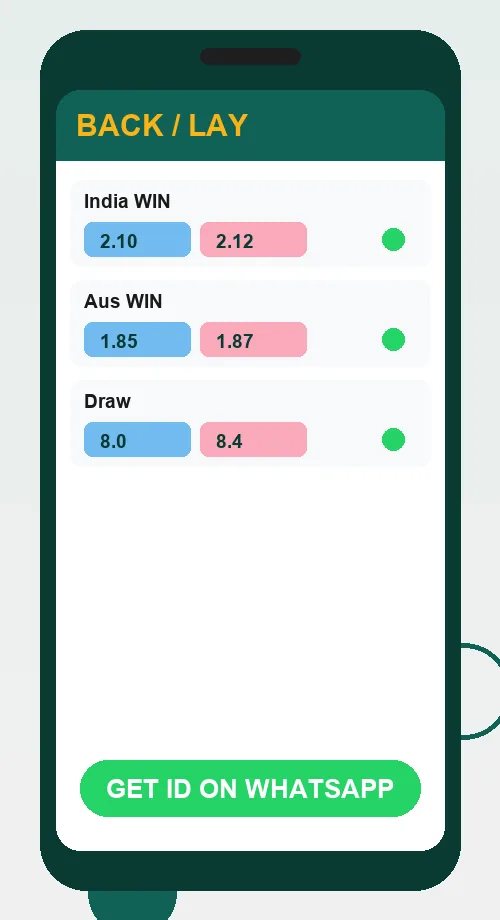
The blue side. You back India to win at 2.10 with 1,000: if India wins you collect 2,100 (your 1,000 back plus 1,100 profit, before commission). If India loses, your 1,000 is gone. Every bookmaker bet you’ve ever placed was a back bet at worse odds — the bookmaker’s margin is baked into their price, while on the exchange the price is set by other players and the operator takes commission only from net winners.
What the card above shows is the shape of every back bet: a fixed, known downside (the stake) and an upside that scales with the odds. That fixed downside is why backing is the right place to start. You can put 500 on a price, watch the market move, and learn how prices behave without ever needing to think about a second number. The panel asks for one figure — your stake — and tells you the profit; nothing on the slip can surprise you later.
The one thing beginners miss on the back side is that the price you are offered is the best pink price currently unmatched — you are matching against someone else’s lay. If you type a higher price than the market shows, your bet sits unmatched until a layer meets you there. The matched vs unmatched guide covers that queue in detail, and it matters much more once you start trading both sides.
Lay: it doesn’t

The pink side — the one bookmakers never offer, because it’s their side. Laying India means you win if anything other than an India victory happens. You accept a backer’s 1,000 at 2.12; if India loses you keep it, and if India wins you pay out 1,120 (your liability: stake × (odds − 1)). Laying shines when your view is negative (“this team is overpriced”) — an opinion that’s unusable at a bookmaker.
Notice the reversal in the card: on a lay, the amount you type is what you stand to win, and the amount you risk is calculated from the odds. That single inversion causes most lay-betting accidents. A player used to typing “1,000” as the amount they can lose types “1,000” on a lay at 5.0 and has quietly risked 4,000. The panel displays the liability in the slip before you confirm — it is the number in the pink box, and until reading it is a reflex you should not be laying anything above 2.0.
The second thing the card is telling you is where a lay is strong: short prices. Laying at 1.30 risks only 300 to win 1,000, so a negative opinion on a heavy favourite is cheap to express. Laying at 6.0 risks 5,000 to win 1,000, so a negative opinion on an outsider is expensive and, most of the time, unnecessary — you would simply back the other side instead. Lay the short, back the long: that rule alone keeps liability sane.
Liability math — the table to keep on your phone
Before any scenario, the arithmetic. Two columns matter: how much a fixed 1,000 lay stake risks at each price, and how much you should type if you want your risk fixed at 1,000 instead. The second column is the one experienced layers actually use, because it turns every lay into a bet with a known downside — exactly like a back bet.
| Lay odds | Implied chance | Liability on 1,000 stake | Stake for 1,000 liability |
|---|---|---|---|
| 1.20 | 83% | 200 | 5,000 |
| 1.50 | 67% | 500 | 2,000 |
| 2.00 | 50% | 1,000 | 1,000 |
| 3.00 | 33% | 2,000 | 500 |
| 5.00 | 20% | 4,000 | 250 |
| 8.00 | 12.5% | 7,000 | 143 |
Two formulas generate every row: liability = stake × (odds − 1), and its inverse, stake = liability ÷ (odds − 1). The pivot is 2.00, where stake and liability are equal. Below it, laying is cheaper than backing the other side; above it, each step up the ladder multiplies what you are risking while your possible win stays frozen at the stake. If you remember nothing else from this page, remember that a lay at 8.0 is a 7-to-1 bet against you in cash terms, however confident the opinion behind it.
The implied-chance column is there because it is the honest way to decide whether to lay at all. Laying at 3.00 only makes sense if you believe the selection’s true chance is meaningfully below 33 per cent — if you think it is 30 per cent, the edge is thin and the 2,000 liability is doing a lot of work for a small expected gain. The exchange odds guide goes deeper into converting prices to probabilities; this table is the lay-side shortcut.
The real trade: back high, lay low

Here’s the sequence from the diagram, with actual numbers:
- Pre-toss: back India 1,000 @ 2.10. Exposure: −1,000 if they lose, +1,100 if they win.
- India’s powerplay goes well. The market re-prices them: back 1.58 / lay 1.60.
- Lay India 1,312 @ 1.60. Liability 787.
- Result — either way you profit: India wins: +1,100 − 787 = +313. India loses: −1,000 + 1,312 = +312. A locked ~312 before the innings break. That’s a “green book”.
The diagram is worth studying for what it does not require: you never needed India to win. You needed the price to move from 2.10 to 1.60 and you needed to act on it. A trade is an opinion about a price’s direction over the next few overs, not about the result, and that is why traders can be profitable on matches they called wrong. The 312 is smaller than the 1,100 you would have collected by holding a winning back bet, and larger than the −1,000 you would have eaten had India then collapsed — that trade-off is the whole discipline.
The hedging formulas for every direction
The note above gives one formula; there are really three situations, and it pays to be able to run each on a calculator during an innings break. In all of them, S is the original stake, B the original odds and C the current odds on the opposite side.
| Situation | Closing bet | Locked result (either outcome) | Example |
|---|---|---|---|
| Backed at B, price shortened to C | Lay S × B ÷ C | Profit = S × (B ÷ C − 1) | 1,000 @ 2.10, lay @ 1.60 → +312 |
| Backed at B, price drifted to C | Lay S × B ÷ C | Loss = S × (1 − B ÷ C) | 1,000 @ 2.10, lay @ 3.00 → −300 |
| Laid at B, price drifted to C | Back S × B ÷ C | Profit = S × (1 − B ÷ C) | Lay 1,000 @ 1.60, back @ 2.10 → +238 |
Row two is the one nobody wants to use and everyone should. You backed at 2.10, the openers fell early and India now trades at 3.00. Laying 700 there (1,000 × 2.10 ÷ 3.00) fixes your loss at 300 whichever way the match ends. Holding on instead means risking the full 1,000 in the hope of a recovery — which is fine if that is a decision, and ruinous if it is simply the hurt of admitting the read was wrong. Write your exit price before you enter and this row becomes routine.
Row three is the mirror trade: lay low, back high. Lay India 1,000 at 1.60 pre-toss (liability 600) because you think the favourite is too short. Two early wickets drift them to 2.10; back 762 there (1,000 × 1.60 ÷ 2.10). If India wins: −600 + 762 × 1.10 = +238. If India loses: +1,000 − 762 = +238. Same green book, opposite starting side — which is why the choice of back or lay is about which way you expect the price to travel, not about who you expect to win.
Lay the draw and lay the favourite — the two classic scenarios
Lay the draw is the Test-match trade. The draw sits at, say, 3.50 on the morning of day four with the pitch still true. You believe a result is far more likely than 29 per cent — the forecast is dry, the third innings is moving fast and both captains want a win. Lay the draw with a 500 stake: liability 1,250. By tea the fourth-innings target is set, the draw drifts to 6.00, and you back it for 500 × 3.50 ÷ 6.00 = 292. Locked profit 208 either way, without needing to know which team wins. The failure case is just as important: rain arrives, the draw shortens to 2.00, and closing costs you 500 × 3.50 ÷ 2.00 = 875 backed at 2.00, a locked loss of 375 — still far smaller than the 1,250 liability you would eat if the match is drawn.
Lay the favourite is the T20 version. A chasing side opens at 1.45 (implied 69 per cent) on a fresh pitch where you rate them nearer 60 per cent. Lay 2,000 at 1.45: liability 900. Two powerplay wickets and the price is 2.20; back 2,000 × 1.45 ÷ 2.20 = 1,318 and you lock 682 on every outcome. If instead they cruise to 1.20, closing costs 2,417 backed at 1.20 and locks a 417 loss — or you hold and risk the full 900. The stat card alongside is the point: on both scenarios the lay is placed at the short end, where liability is modest, and the profit comes from the price lengthening.
Neither trade needs a genius read. They need a price that is short for a reason you disagree with, a stake sized from the liability column rather than the stake column, and an exit written down before the first ball. Everything else is arithmetic.

A full T20 trade, toss to the sixteenth over
The screen alongside is the kind of ladder you will be watching. Here is a complete evening on it. Pre-match: Mumbai bat first at a venue with a strong chase record; the market prices them 2.04 / 2.06. Your read from the pitch report is that the evening is dry — no dew — so batting first is far less of a handicap than the venue’s reputation suggests. When the toss lands and the market over-corrects to 2.20, you back Mumbai 2,000 at 2.20. Exposure: −2,000 / +2,400.
Powerplay: Mumbai reach 62 without loss after six and trade at 1.70 / 1.72. Rather than green fully, you lay half the equal-profit stake — 1,279 at 1.72, liability 921. Position now: Mumbai win +1,479, Mumbai lose −721. You have banked most of the downside protection and kept upside. Middle overs: a collapse to 130 for 6 after fifteen sends the price to 2.60. Your read is that 165 gets defended here about 40 per cent of the time; the market says 38. No edge either way, so you do nothing — which is a decision, not an absence of one. Mumbai close on 178 for 8.
The chase: the opponents are 55 for 2 after six (Mumbai 2.10) and 110 for 4 after thirteen (1.95). Then two wickets in the fifteenth over: Mumbai 1.40 / 1.42. Time to close. With an uneven position, the closing lay stake L solves 1,479 − 0.42L = −721 + L, so L = 2,200 ÷ 1.42 = 1,549 at 1.42, liability 651. Final book: Mumbai win +1,479 − 651 = +828; Mumbai lose −721 + 1,549 = +828. Locked before the sixteenth over, with commission due once on the 828 net.
Read the whole evening back and count the bets: three. Every other moment on the ladder was watched, not traded. That ratio — many prices seen, few acted on — is what a profitable trading night looks like, and it is the opposite of what the speed of the screen invites.
Matched vs unmatched — when your lay only half fills
Every closing bet above assumed the full stake matched at the price you saw. In a busy IPL market it usually does; in a quieter series it often does not, and an unmatched remainder quietly breaks your green book. Take the powerplay lay in the T20 trade: you offer 1,279 at 1.72 but only 800 is available on the blue side at that price. 800 matches, 479 sits in the queue, and your position is now lop-sided — protected on 800, still fully exposed on the rest.
You have three choices, and the wrong one is the default of ignoring it. First, leave the remainder: if the price ticks back to 1.72 it fills on its own, and a partial green is still a green. Second, cancel the remainder and re-lay at the price now showing — say 1.68 — recalculating from the unprotected portion of the original back rather than from the leftover 479, which is the cleaner way to think about it. Third, take the market price immediately by laying at the best available blue price so that nothing is left unmatched. Each is fine; what is not fine is discovering at the sixteenth over that a third of your hedge never existed. The matched vs unmatched guide walks through the queue mechanics and the in-play delay that makes partial fills more common on live markets.
When NOT to lay
Laying is a tool, and the mark of someone who has learned it is knowing when to put it down. These are the situations where the pink side is the wrong answer:
- Long odds without a bankroll reason. Laying at 8.0 risks seven times the stake to win one. If your view is “the outsider will not win”, backing the favourite expresses the same opinion with a fixed downside. Lay above 4.0 only when your staking plan has sized it from liability, never from habit.
- Thin liquidity. If the blue column shows a few hundred rupees at the price, a lay of 2,000 will match in pieces at worsening prices or not at all. Laying into an empty book is how partial fills become losses.
- “Covering” a losing back. Laying the team you backed after the price has moved against you is a hedge — row two above — and it is legitimate. Laying the other team to “make it back” is a second, unrelated bet placed in a bad mood. Do the arithmetic; if the second bet only makes sense because the first one hurts, it does not make sense.
- Immediately after a wicket. The in-play bet delay exists because the price is about to move. A lay placed on the reaction lands after the market has repriced, usually at a worse level than you saw. Place ahead of the event or wait for the new price to settle.
- Because the favourite is “too popular”. Crowds are sometimes right. A short price on a strong side chasing on a flat deck is short for a reason; laying it requires a specific disagreement — pitch, injury, dew, matchup — not a general feeling that favourites lose.
- Without knowing the void rules. A lay that would win if rain washes out the match does not win — the market voids. Read the settlement rules before laying on a weather-threatened evening.
When to use which
- Back when your read says an outcome is more likely than the odds imply.
- Lay when a price looks too short — favourites after hype, teams defending small totals on flat decks.
- Both when you want to trade the swing rather than hold to the result — the powerplay and death overs move prices most (the IPL guide maps those windows).
| Your view | Right side | Why | Risk you carry |
|---|---|---|---|
| Selection is underpriced (true chance higher than implied) | Back | Profit scales with odds; downside fixed at stake | The stake |
| Short-priced selection is overpriced | Lay | Liability below stake when odds are under 2.0 | Stake × (odds − 1) |
| Long-priced selection is overpriced | Back the other side | Same opinion, fixed downside, no liability multiplier | The stake |
| Price will move, result uncertain | Back then lay, or lay then back | Trade the swing and close before the result | Whichever leg is open |
| No clear disagreement with the price | Neither | No edge means no bet — watch the over instead | None |
The Indian exchange context — terms, payments and the law
On Indian panels the two sides have Hindi names you will hear in every WhatsApp group: lagai is the back (blue) and khai is the lay (pink), bhaav is the price, and “book bana lo” means green up. Sessions and fancy show the same two sides as Yes and No. None of this changes the maths on this page — a khai at 1.60 carries exactly the liability the table shows — but knowing the vocabulary stops you mis-clicking when a friend says “Mumbai pe khai lagao” and means lay, not back.
Funding is by UPI through your ID provider rather than a card on the platform; the deposit guide covers timing so that the balance is there before the toss and not requested mid-powerplay. Remember that a lay reserves its full liability from your balance, so a 2,000 lay at 3.00 needs 4,000 available, not 2,000 — the most common “insufficient balance” message new layers see is a liability they did not expect. Payouts go back by the same route; the withdrawal guide explains the verification step.
Two legal notes worth taking seriously. Online betting rules differ by state in India, and some states restrict it outright, so read the legality page for your own state before opening an ID. And the platform is strictly 18+: an exchange is an adult financial instrument, and lay betting in particular — with its multiplied liability — is not something anyone should learn with money they cannot afford to lose.
Glossary
- Back (lagai)
- Betting that a selection wins. Blue side. Risk is the stake; profit is stake × (odds − 1).
- Lay (khai)
- Betting that a selection does not win. Pink side. Profit is the stake; risk is the liability.
- Liability
- What a lay costs if the selection wins: stake × (odds − 1). Reserved from your balance while the bet is live.
- Green book
- A position showing a profit on every outcome, produced by backing and laying the same selection at different prices.
- Red book
- The same structure with a locked loss — the outcome of hedging after a price moved against you.
- Hedge
- Any opposing bet placed to reduce exposure; greening up is a hedge that happens to be profitable.
- Matched / unmatched
- A bet is matched when another player has taken the other side at your price; until then it waits in the queue and provides no protection.
- Equal-profit stake
- The closing stake that makes both outcomes pay the same: original stake × original odds ÷ current odds.
How back and lay fit the rest of your betting
This page is the grammar; the rest of the library is what you say with it. The odds guide teaches the probability reading that tells you which side to be on. The in-play guide is where the back-then-lay trade actually happens, with the bet delay and the live ladder. Session betting is the Yes/No version at rapid tempo — the best possible practice for lay thinking with small numbers. And the bankroll guide supplies the one rule that makes laying safe: size every lay from its liability, in units, off a balance you set before the match.
If you are brand new, the sequence is: get an ID, back only for a fortnight, add short-priced lays with the liability column open, then trade your first swing on a powerplay with the equal-profit formula on a calculator. The mistakes guide lists what tends to go wrong at each of those stages so you can skip the expensive lessons.
Next reads: how the odds ladder prices probability · session betting, where lay thinking gets rapid-fire practice.
Ready to try the sequence with real prices? An exchange ID takes a few minutes over WhatsApp, and the team will explain the liability box on the slip before your first lay if you ask.