Cricbet99 IPL Betting — A Plan for All 74 Nights

The IPL is the exchange player’s festival: two months, seventy-odd matches, and on every one of them a live board of match odds, session lines and fancy markets moving ball by ball. It’s also where undisciplined bankrolls die by mid-April. This guide is the plan for both truths: how the toss, venue and dew set every price; where the powerplay and death-over windows open and close; a session strategy for each phase; how to read the live board; a match-night routine you can run on autopilot; and the bankroll arithmetic for a season that lasts long enough to punish every shortcut.
Match odds rhythm — the three windows

IPL prices don’t drift randomly; they swing in three predictable windows. The toss: chase-friendly venues re-price sides instantly — knowing each ground’s chase bias is free edge. The powerplay: six overs of field restrictions where a good start can halve a price (the back-high-lay-low trade from the back-vs-lay guide lives here). The death overs: maximum volatility, where matches — and careless traders — are finished.
The card above is the shape of a typical evening: two sharp steps and a long slow slope between them. A side that opens at 1.90 might trade 1.75 after winning the toss and choosing to chase, sit anywhere from 1.40 to 2.60 by the end of the first powerplay, drift a tick or two an over through the middle, and then move twenty ticks a ball once the chase reaches the sixteenth over. Everything in this guide follows from that shape — the trades happen at the steps, the patience happens on the slope.
It also tells you where not to be busy. The middle overs look like an opportunity because the screen is still moving, but the moves are small and the market is usually right about them. Most losing IPL bets are placed between the seventh and fifteenth overs by people who wanted something to happen, and the honest fix is to treat that phase as viewing time with one session line at most.
Toss, venue and dew — the pre-match triangle
Before a ball is bowled, three things set the opening price, and they interact. The venue supplies a par score and a chase record. Dew, which arrives at evening games in the second half of the season and at humid coastal grounds throughout, makes the ball slippery for the bowling side in the second innings and pushes the chase advantage further. The toss then decides which side gets the benefit. A team that wins the toss at a dewy chase-friendly ground has just been handed a real, measurable edge, and the market prices it within seconds.
| Factor | What to check before the toss | Effect on the opening price | Trade it if… |
|---|---|---|---|
| Venue par score | Last five first-innings totals here, not the five-year average | Sets session lines and the “defended total” threshold | The market’s par looks stale against recent scores |
| Chase record | Share of evening games won by the chasing side this season | Chasing side shortens 5–15 ticks after the toss | The move overshoots what the record justifies |
| Dew forecast | Humidity and temperature drop after 8pm; dry-weather afternoons | Amplifies chase bias; suppressed on dry nights | A dry evening at a “dew ground” leaves batting first underpriced |
| Afternoon game | Weekend 3.30pm starts | Chase bias largely disappears | The market applies the evening chase premium anyway |
| Toss result | Who bats first and why the captain chose it | Immediate reprice | Only if your venue read disagrees with the size of the move |
The right-hand column is the discipline: none of these factors is a bet on its own. They become a bet only when the market’s reaction is out of line with what the venue history and the weather say. A chasing side going from 1.90 to 1.75 at a ground where chasers have won eight of ten evening games is fair; the same move at a ground where the split is even, on a dry night, is a lay. The exchange odds guide shows how to turn those ticks into implied percentages so the comparison is a number, not a feeling.
Powerplay and death-over price windows — with numbers
The two fast windows behave differently, and a trader should have a different plan for each. The powerplay is an information window: six overs decide whether the pitch is what the report said, whether the openers are set, and whether the new ball is doing anything. Take a batting-first side opening at 2.10. A 58-for-none powerplay usually takes them to about 1.65; a 32-for-three powerplay pushes them to 2.80 or beyond. That is a twenty-five per cent swing in implied probability in twenty-four minutes, in either direction, and it is the best trading window of the night precisely because it is early enough that a position can still be closed calmly.
The classic powerplay trade is the one from the back-vs-lay guide: back at 2.10 pre-toss on a venue read, lay at 1.65 after a good start for a stake of 2.10 ÷ 1.65 times the original — roughly 1.27 times — and lock a profit of about 27 per cent of the stake whichever way the match ends. The reverse works just as well: a lay at 1.75 on a chasing side you think is too short, closed with a back at 2.40 after two early wickets, locks about the same. Write the closing price before the first over, because the powerplay does not leave time for arithmetic.
The death overs are a volatility window, not an information one. By the sixteenth over of a chase everybody knows the state of the game; what changes on each ball is the probability, and it changes violently. A side needing 40 off 24 with six wickets in hand might trade 1.70; one wicket and a dot ball later it is 2.20; a six and it is 1.50. Trading that is possible but it is a different skill — reaction speed against a bet delay, with a full bankroll exposed to a single delivery — and most players are better served by having their match odds position already green before over sixteen and using the death overs for small fancy stakes instead. The in-play guide covers the delay and the temperament the window demands.
Session strategy by phase
Session lines — runs at six, ten, fifteen and twenty overs — are the IPL’s middle layer, and their character changes with the phase they cover. Treating every session the same is the second most common way to lose money on the exchange during April.
| Phase | Session line behaviour | What drives it | Sensible approach |
|---|---|---|---|
| Powerplay (1–6) | Most volatile; moves 4–6 runs on a boundary or wicket | New ball, field restrictions, opener intent | One bet at most, placed pre-toss on a venue read; never chase the line |
| Middle (7–15) | Most honest; small steady moves | Spin, run-rate discipline, wickets in hand | Best session to learn on; take No after a flattering start, Yes when set batters face part-timers |
| Death (16–20) | Explosive; line can jump 8 runs in an over | Death bowlers, wickets in hand, required rate | Small stakes only; prefer over-runs fancy lines to the full session |
| Second innings | Anchored to the target rather than to par | Required rate, dew, chasing side’s depth | Sessions here are effectively match-odds bets — size them that way |
The middle-overs row deserves the emphasis. Because the phase is quiet, the fifteen-over line is where the market is most often simply right, which makes it the safest place to practise the Yes/No mechanic with small money and the wrong place to look for a big edge. The powerplay and death rows are the opposite: real edge exists, but so does real tilt, and the stake sizes should reflect that. The session betting guide works several of these phase-specific reads through with actual lines.
Reading the live board on a match night
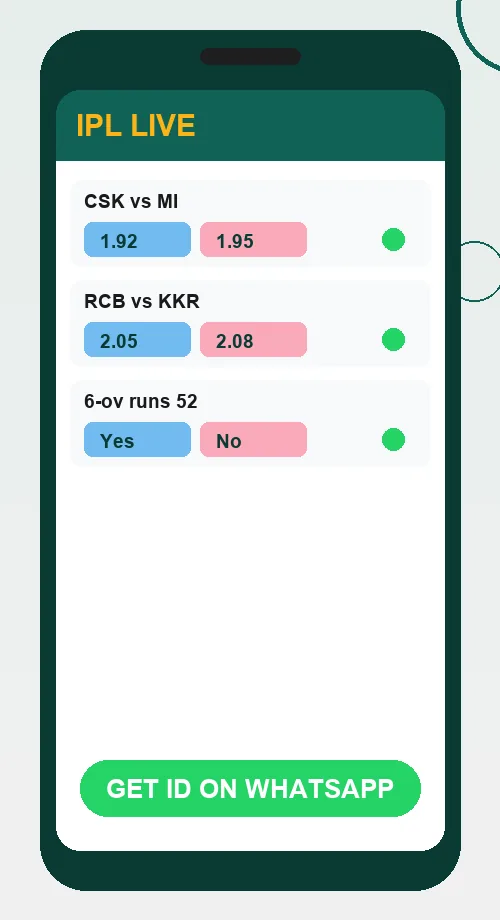
The screen alongside is what an IPL evening looks like on the exchange: match odds at the top with a blue back column and a pink lay column, the current session line and its Yes/No rates under it, and the fancy board — player runs, over runs, partnership, boundaries — stacked below with each line’s two rates. Learn to read it top-down and left-right in a fixed order, because the panel is designed to show everything at once and the untrained eye goes straight to whatever is flashing.
Start with the match odds pair. The gap between the best back and best lay price is the spread; on a busy IPL match it is a tick or two, and a wider gap means thin liquidity and a market that will move against your order. Then the volume beside each price: the amount you can match at that level right now. A lay of 5,000 into a column showing 800 will fill in pieces at worsening prices, which is the matched-versus-unmatched problem in its most expensive form. Then, and only then, the session line and its rates — noting which side is paying less, because that is the side the market favours.
The fancy board is read last and selectively. A big match can show forty lines and you are looking for two or three where your pre-toss homework disagrees with the number, not for whichever line has just moved. A line that jumped after a boundary is the market’s reaction; your reason to bet has to be something the market has not yet weighed, such as the bowler who is due next or the batter’s record against him.
One practical habit: keep the balance and the current exposure figure visible at all times. The board makes it easy to place five bets in ten minutes and lose track of what is actually at risk; the exposure figure is the honest total, and when it reaches the per-match cap the evening’s betting is over regardless of how the board looks.
A disciplined match-night plan

- Pre-toss: read the pitch report and venue chase record; position small on match odds if the price disagrees with the ground’s history.
- Powerplay: trade the swing — this is the highest-information window; a wicket or a 16-run over re-prices everything.
- Middle overs (7–15): the drift. Session lines are most honest here; match odds least interesting. Most losing bets in IPL history were boredom bets placed now.
- Death overs: fancy peaks — over runs, total sixes, next-wicket. So does risk: pre-commit your stakes before over 16 and stop when they’re gone.
The diagram is the four phases; here is the routine wrapped around them, in clock time for a 7.30pm start. 6.45pm: balance loaded by UPI (never during the match — see the deposit guide), per-match cap written down, venue notes open, likely elevens checked. 7.00pm, toss: compare the market move against your venue read; bet only on a disagreement, at no more than a fifth of the cap. 7.30–8.00pm, powerplay: one trade, with the closing price already decided. 8.00–8.40pm, middle: at most one session line; otherwise watch. 8.40–9.00pm, death: the pre-committed fancy stakes and nothing more. Innings break: green up or accept the position, then repeat for the chase. Stumps: log the night’s bets and result in a note before closing the app.
The log is not optional. Over seventy matches, memory is a liar — it remembers the green books and forgets the middle-overs leaks — and a two-line note per match (what you bet, why, result) is the only way to find out in week three which of your habits is actually making money. Players who keep the log tend to discover that their toss and powerplay bets are profitable and their death-over fancy is not, or the reverse, and adjust; players who do not simply feel that the season “went badly”.
Bankroll: the 74-match math

Decide the season number first — the amount that can vanish without touching your life. Divide across the matches you’ll genuinely bet (nobody should bet all 74). That per-match figure is a hard cap, and the fastest way to make it hard is telling our team to enforce it. Season bonuses (check what’s live) stretch the bankroll; they never justify raising it.
Here is the arithmetic on a concrete plan. Season budget: 35,000. Matches you will actually bet: 35 — half the fixtures, chosen because you have done the pre-toss work, not because they are on. Per-match cap: 1,000. Unit: 200, so that no single bet is more than a fifth of the night and a bad powerplay trade does not end the evening. That is five units per match — typically one at the toss, one or two in the powerplay, one session, one or two fancy at the death — and it means a winning night is up perhaps 400 to 600 and a losing night is down at most 1,000. Across 35 nights, that is a season whose worst case is the number you chose in March, and whose realistic range is decided by the quality of your reads rather than by one bad Tuesday.
| Season budget | Matches bet | Per-match cap | Unit (1/5 of cap) | Worst-case season |
|---|---|---|---|---|
| 15,000 | 30 | 500 | 100 | −15,000 |
| 35,000 | 35 | 1,000 | 200 | −35,000 |
| 70,000 | 35 | 2,000 | 400 | −70,000 |
The worst-case column is deliberately blunt: it is the season budget, because that is what a per-match cap guarantees and nothing less. Anyone whose plan does not have a worst case they can look at calmly has not made a plan. Two refinements from the bankroll guide carry over intact: never raise the unit after a winning week (the reads got better, the variance did not go away), and never raise the cap after a losing one (that is chasing with a calendar). A mid-season review at the halfway point is the one legitimate moment to change the numbers, and only downward if the log says the reads are not working.
Season mistakes and the fix for each
Betting every match. The stat card alongside is the point: the edge comes from the matches you researched, and it is diluted to nothing by the ones you did not. Fix: decide at the fixture release which nights are yours, and watch the others without a balance open.
Adding to a losing match odds position. A back at 2.10 that drifts to 3.00 feels like a better price now, and it is — but the read that put you there has just been proven wrong by six overs of cricket. Fix: hedge to a small red book as the back-vs-lay guide shows, and take the fresh view on the next match, not this one.
Middle-overs boredom bets. The single biggest leak in an IPL season. Fix: a rule that the seventh to fifteenth overs carry one session line at most, placed with a reason, or nothing.
Death-over fancy without a pre-commitment. Over-runs and next-wicket lines settle every few balls, and a losing sequence can burn a night’s cap in two overs. Fix: the death-over stake is decided before over sixteen and is physically the last money for the match.
Raising the unit after a hot week. A winning fortnight in April feels like skill and is partly variance. Fix: the unit is fixed for the season; extra profit is withdrawn, not staked — the withdrawal guide covers moving it out.
Bonus-driven betting. A season refill with a ten-times rollover pushes you into bets you would not otherwise place. Fix: read the terms, and take only a bonus whose rollover you would have bet anyway. The common mistakes guide covers the general versions of all six.
The Indian season — payments, timing and the rules
The IPL runs on India’s clock, and so should your betting admin. Evening matches start at 7.30pm, double-headers on weekends start at 3.30pm, and the busiest UPI windows of the night are the ten minutes before the toss and the innings break — which is exactly when a deposit request is slowest to land. Load before 7pm, or the previous night. If you withdraw during the season, do it on a morning after a winning night rather than at the innings break; verification is quicker when the support queue is quiet.
The vocabulary you will hear in every match-night group is the exchange’s Hindi register: lagai and khai for back and lay, session for the runs-in-overs line, lambi for the full innings total, fancy for everything else, and “book bana lo” for greening up before the death overs. A tip like “Chennai khai 1.75, dew nahi hai aaj” is a lay of the chasing side on a dry-night read — exactly the pre-match triangle above, in five words.
Two things to keep straight through the noise of a two-month festival. Online betting law differs by state and some states restrict it; the legality page sets out the position and you should read it for your own state before creating an ID. And the platform is 18+ without exception. The IPL is entertainment first, and a season plan is only worth following if it keeps the money inside the boundary you set while thinking clearly — the limit and cool-off tools are there for the night that boundary feels far away.
Glossary for the season
- Chase bias
- The share of matches at a venue won by the side batting second; the main input to the post-toss price move.
- Dew factor
- Evening moisture that makes the ball hard to grip for second-innings bowlers, favouring the chase.
- Par score
- The first-innings total at which the market rates both sides roughly even at a given venue.
- Powerplay
- Overs one to six, with only two fielders outside the circle; the highest-information window of the innings.
- Death overs
- Overs sixteen to twenty; the highest-volatility window, where match odds move most per ball.
- Session
- A runs line on the innings total at a set over count, with Yes and No sides.
- Per-match cap
- The rupee amount one match is allowed to cost, fixed before the toss and never revised during play.
- Green book
- A match odds position showing a profit on both outcomes, usually built in the powerplay and closed before the death.
How the IPL plan fits the rest of your betting
Everything in this guide is the season-long application of skills taught elsewhere in the library. The odds guide supplies the probability reading that turns a toss move into a number; the back-vs-lay guide supplies the powerplay trade; the session guide and the fancy guide supply the middle and death-over layers; and the bankroll guide supplies the unit arithmetic that makes seventy nights survivable. Commission applies once per market on net winnings, so a green book built across several trades on one match is charged on the final figure, not on each leg.
If you are starting fresh for the season, the order is: get an ID in the week before the opener, run the pre-toss routine on the first three matches with match odds only, add a middle-overs session line in week two, and reserve fancy for the death overs from week three. By the playoffs you will have a log, a unit and a set of venue reads that are yours — which is a better position than most people reach after several seasons of betting on feel.
Ready for the first toss? An exchange ID takes a few minutes over WhatsApp, and you can ask the team to set your per-match cap at the same time so the season starts with the discipline already in place.