Cricbet99 Commission — The Honest Price of Better Odds

Nothing in betting is free — the only question is whether you can see the fee. Bookmakers hide theirs inside the odds. The Cricbet99 exchange shows its fee in daylight: a small commission on net market winnings, charged only when you finish a market in profit. This guide covers exactly when it applies and when it does not, works the arithmetic across a full evening of bets, compares it to a bookmaker’s margin over a whole season, shows how it interacts with greening up, and finishes with the adjustments — small ones — it should make to your value math.
When commission applies — and when it doesn’t

The card above is the whole rule, and it is worth reading it twice because most confusion about commission comes from adding conditions that are not there. Commission is a percentage of your net profit on a single market, taken at the moment that market settles. It is not a percentage of your stake, not a percentage of your balance, not a fee for placing a bet, and not something that appears on a losing market to make the loss worse. If a market closes and you are not in profit on it, the commission line for that market is zero.
“Net” is the operative word. If you placed several bets on the same market — backed early, laid later, backed again on a drift — the exchange adds every leg together at settlement, and only the total, if positive, is commissioned. Ten bets on one market with a combined profit of 400 are charged exactly as one bet with a profit of 400. That is why active traders are not penalised for activity, and it is the property everything else on this page rests on.
- Applies: when a market closes with you in net profit. Win 1,000 net on match odds at 3% → 30 goes to the platform, 970 to you.
- Doesn’t apply: losing markets (no fee on top of a loss), voided bets, deposits, withdrawals, or unmatched bets that never entered the market.
- Per market, net: trade in and out ten times — only the final net profit of that market is commissioned. A session market and a match-odds market on the same game are two separate markets, each settled on its own.
A full evening, market by market
Here is a realistic T20 night for a player using 1,000-rupee units, with five markets touched and a 3% rate. The point of the table is the last two columns: commission is worked out per market, and losing markets contribute nothing to it — but they also do not reduce it.
| Market | What happened | Net result | Commission (3%) | Banked |
|---|---|---|---|---|
| Match odds (pre-match back) | Backed 1,000 at 2.00, won | +1,000 | 30.00 | +970.00 |
| Session, overs 1-6 | Backed the under, lost | −500 | 0 | −500.00 |
| Session, overs 7-10 | Backed the over at 1.80, won | +400 | 12.00 | +388.00 |
| Fancy, batter runs | Laid at 2.50, lost | −300 | 0 | −300.00 |
| Match odds (in-play trade) | Back 2.10, lay 1.60, greened | +312.50 | 9.38 | +303.12 |
| Evening total | Gross wins 1,712.50 · losses 800 | +912.50 | 51.38 | +861.12 |
Two things to notice. The commission bill for the whole evening is 51.38 on gross winnings of 1,712.50 — three percent of the wins, as promised, and zero on the two losing markets. But it is not three percent of the evening’s net profit of 912.50, which would have been 27.38. The losses on the session and fancy markets did not offset the commission on the winning markets, because commission is settled market by market, not on your night as a whole. Players who assume it nets across the evening are consistently surprised by about that much, and now you will not be.
The practical effect is small but real: a player who wins and loses in lots of small separate markets pays slightly more commission relative to net profit than one who concentrates the same activity inside fewer markets. It is not a reason to change how you bet — session markets are worth playing on their own merits — but it is worth understanding, because it is the honest answer to “why was my commission higher than I expected?”
Commission vs margin — the season math

The chart draws the comparison that decides whether an exchange is worth learning: what each fee model costs over the same run of bets. The bookmaker bar is tall and flat because its margin is paid on every bet, win or lose. The exchange bar is short because commission is paid only on the winning half, and only as a share of the profit rather than of the stake. The gap between the bars is not a marketing claim; it is arithmetic you can check with the numbers below.
Take 100 bets of 1,000 on outcomes that are genuinely 50/50. A fair price is 2.00. A bookmaker running a 7% overround offers roughly 1.87 on each side instead — sum 100 ÷ 1.87 twice and you get 107%. On the exchange the ladder sits at about 2.00 with a 3% commission on wins.
| Bookmaker at 1.87 | Exchange at 2.00, 3% commission | |
|---|---|---|
| 50 winning bets | 50 × 870 profit = +43,500 | 50 × 1,000 profit = +50,000 |
| 50 losing bets | −50,000 | −50,000 |
| Fee paid | Built into the price — about 6,500 | 50 × 30 = 1,500 |
| Expected result | −6,500 | −1,500 |
Same betting, same results — the exchange player is roughly 5,000 better off per hundred bets from the fee structure alone, before any skill is involved. A bettor with no edge at all loses about a quarter as much on the exchange as at the bookmaker; a bettor with a small edge can be profitable on the exchange and still losing at the book, because the edge that clears 3% on wins does not clear 7% on everything. And that is before the extra advantage of being able to lay and trade at all, which a bookmaker never offers.
Step-by-step: calculating commission on any settlement
The arithmetic is short enough to do in your head between overs, and being able to do it is what stops commission from ever feeling like a surprise. Here is the routine, then three examples that cover every case you will actually meet.
- List every bet on the market — backs and lays, matched only. Unmatched bets never settled and do not count.
- Work out each leg’s result. A winning back pays stake × (price − 1); a losing back costs the stake. A winning lay pays the lay stake; a losing lay costs lay stake × (price − 1).
- Add the legs together. This is the net result for the market.
- If the total is positive, multiply by your rate. That is the commission. If the total is zero or negative, commission is zero.
- Subtract commission from the net result to get what is credited to your balance.
Example one — a single back. Back 2,000 at 1.75, wins. Leg result: 2,000 × 0.75 = +1,500. Net +1,500; commission 45; credited +1,455.
Example two — a lay that wins. Lay 1,500 at 3.20 on a batter to top-score; he does not. Leg result: +1,500 (you keep the backer’s stake). Net +1,500; commission 45; credited +1,455. Had he top-scored, the leg would have cost 1,500 × 2.20 = 3,300, net −3,300, commission zero.
Example three — a mixed market. Back 1,000 at 2.40 (wins, +1,400), then lay 800 at 1.90 later in the same market (loses because the outcome won, −720), then back another 500 at 1.50 (wins, +250). Legs: +1,400 − 720 + 250 = +930. Commission 27.90; credited +902.10. Note that the losing lay reduced the net before commission was calculated — inside one market, losses do offset.
How greening up interacts with commission
Greening up — laying a position you backed, or backing one you laid, at a better price so that you profit whichever outcome wins — is the move that makes the exchange an exchange, and commission is designed around it. Because all the legs sit on one market, they are settled together and the fee is charged once, on the locked net figure. Take the trade from the evening table: back 1,000 at 2.10, then lay 1,312.50 at 1.60. If the side wins: +1,100 − 787.50 = +312.50. If it loses: −1,000 + 1,312.50 = +312.50. Either way the net is 312.50, commission is 9.38, and you bank 303.12.
Compare that with what a naive reading would fear: commission on the 1,100 the back would have paid, then again on the 1,312.50 the lay pays. That is not how it works, and it never has been. The exchange does not see two winning bets; it sees one market that closed 312.50 in your favour. The card alongside makes the point in one line — you are charged on what you locked, not on what you traded.
The same logic protects you on the way down. If you back at 2.10, the price drifts to 3.00 on a wicket, and you lay 700 at 3.00 to cap the damage, the market closes at a locked loss of 300 whichever way it ends. No profit, no commission. The only thing to remember is that the netting is per market: greening a match-odds position does not net against a session market on the same game, so if you hedge across two different markets each is settled — and commissioned, if in profit — on its own. The in-play guide shows the trade in a live setting.
The number to carry into the season
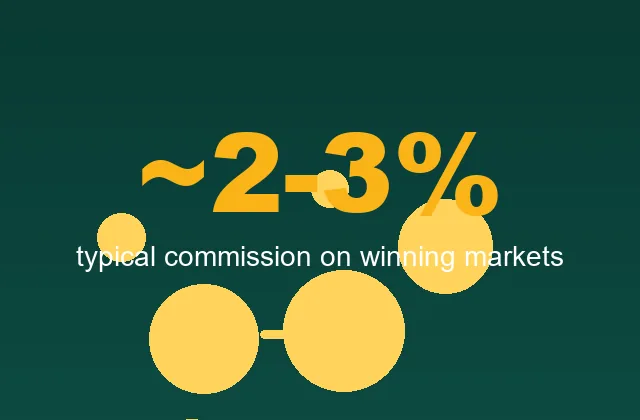
If you remember one figure from this page, make it the one on the card: over a hundred even-money bets, the fee structure alone moves the result by about five thousand rupees per thousand staked. Scale it to your own betting. A player who places three bets a week through a forty-week season is at 120 bets, and the gap grows to roughly six thousand — a month of bankroll for many players, delivered not by a single brilliant read but by the quiet difference between paying on wins and paying on everything.
The stat is also a reminder of what commission is not. It is not a reason to bet less often — the exchange fee scales with profit, not with activity, so a bettor who wins more pays more in absolute terms and is delighted to. It is not a reason to chase larger prices, where the haircut is proportionally the same. And it is not a reason to skip greening up a good position, because the trade is commissioned once on the net. The number simply says that the model is on your side, and the rest is down to the reads.
Where it does earn a place in your planning is expectation. If you keep a record — and the bankroll guide strongly suggests you do — track gross wins, commission and net separately. Over a season, commission should sit at roughly your rate multiplied by gross winnings on winning markets. If it is drifting higher, you are probably spreading the same activity across more small markets, which is fine, but worth knowing.
Working commission into your value math
From the odds guide: a value bet is one where your probability beats the implied probability. Commission raises the bar by a hair, and the neat way to see by how much is to convert any price to its effective price after commission: effective odds = 1 + (odds − 1) × (1 − rate). At 3%, a back at 2.00 becomes 1.97, and the probability you need to be right to break even rises from 50% to 50.8%. The table shows the adjustment across the range you will actually bet in.
| Ladder price | Effective price after 3% | Break-even probability, no commission | Break-even with commission |
|---|---|---|---|
| 1.50 | 1.485 | 66.7% | 67.3% |
| 2.00 | 1.970 | 50.0% | 50.8% |
| 3.00 | 2.940 | 33.3% | 34.0% |
| 5.00 | 4.880 | 20.0% | 20.5% |
The shift is under one percentage point everywhere. A genuine edge — you make it 58%, the market makes it 50% — clears that without noticing. A one-tick edge, where you make it 50.5% against a market 50%, does not. Practical rule, worth memorising: if the bet only works without commission, it doesn’t work. That rule filters out precisely the bets that were never really value in the first place, which is a service, not a cost.
Mistakes players make about commission — and the fixes
| Mistake | What goes wrong | Fix |
|---|---|---|
| Expecting commission on the evening’s net | Bill looks “too high” after a mixed night | It is per market; losing markets do not offset winning ones |
| Fearing commission on every greened leg | Avoiding trades that would have locked profit | One charge on the locked net; trade freely |
| Ignoring it on thin edges | A one-tick edge turns into a small loss over time | Use effective odds; skip edges under one point |
| Raising stakes to “cover” commission | Larger variance for the same expected value | Stake from bankroll units; commission is not a stake input |
| Never confirming the rate in writing | Surprise at first settlement, no recourse | Get the rate for your ID type in the chat before depositing |
Most of these are the same misunderstanding wearing different clothes: treating commission as a tax on betting rather than a share of winning. Once it is filed correctly it stops influencing decisions it should not influence, and the common mistakes guide picks up the remaining behavioural traps.
The Indian context — rate in writing, UPI in full, 18+
Because Indian players reach the exchange through a provider rather than directly, the commission rate is one of the terms that should be in your WhatsApp chat in writing before any money moves — alongside the withdrawal window and any bonus rollover. A provider who states “3% on net winnings, per market” in plain words is one you can hold to it; one who says “bahut kam hai, tension mat lo” has not answered. It is one of the five criteria in the provider rankings for exactly this reason.
On the money side, commission is the only deduction you should ever see. A UPI deposit of 5,000 should credit 5,000; a withdrawal of 4,000 should land as 4,000. If any other figure is shaved off in either direction, ask for the line item in writing — there is no legitimate “processing charge” on either leg. During IPL season, when volumes are high and settlements are frequent, a quick glance at each settlement’s commission line is a cheap habit that catches errors early.
Finally, the parts no fee structure changes. Every market here is 18+, and the legality of online betting varies by Indian state — this page lays out the position honestly. Commission being low is a reason to prefer the exchange model; it is not a reason to bet more than you planned. The deposit limits and cool-off tools exist for the nights when the maths stops being the point.
Glossary
- Commission
- The exchange’s fee: a percentage of net profit on a market, charged at settlement, only when that net is positive.
- Net winnings
- All matched legs on one market added together — wins positive, losses negative. The base commission is calculated on.
- Margin / overround
- A bookmaker’s fee, built into the prices so that implied probabilities sum above 100%. Paid on every bet.
- Effective odds
- A price adjusted for commission: 1 + (odds − 1) × (1 − rate). The number to compare your probability against.
- Greening up
- Taking an opposing position at a better price so profit is locked whichever way the market settles. Commissioned once, on the net.
- Liability
- What a lay costs if the outcome wins: lay stake × (price − 1). Never itself commissioned.
- Void
- A cancelled bet with stake returned. Produces no net profit, so no commission — see the settlement rules.
How commission fits the rest of your betting
Commission is the last line on every settlement, so it touches every other guide without changing any of them. The odds guide teaches you to read a price as a probability; commission nudges the break-even point by under one point, and that is the only adjustment. The back vs lay guide teaches the trade; commission is charged once on the trade’s net, so it is never a reason not to green. The settlement rules decide when a market closes; commission is calculated at that moment and never before.
The one place it belongs in your planning is your records and your expectations: track it, expect it, and let it filter out the bets that were only ever marginal. Then take the winnings out — the withdrawal guide covers what happens next, and it is the point at which a visible fee finally looks like what it is, the honest price of better odds.
Related reading across the full guide library: the Cricbet99 exchange model · how the ID and payment loop works · sizing stakes so commission never matters.