Cricbet99 Win ID vs 1xBet Win ID — Complete 2026 Comparison

1xBet is the maximalist of online betting: tens of thousands of events, a hundred casino providers, odds on television shows. Cricbet99 is the opposite philosophy — a cricket-first exchange that does one thing deeply. Which serves an Indian cricket bettor better in 2026?
Having serviced players who arrived from 1xBet, the pattern in their feedback is remarkably consistent, and it shapes this comparison. They rarely complain about the odds, which are competitive for a bookmaker. They rarely complain about the catalogue, which is unmatched. They complain about three things: finding the market they want inside a dense interface, the KYC and wallet steps that appear at withdrawal time, and the absence of a lay side once they have learned what one is.
The structural difference drives everything else. 1xBet is a sportsbook: fixed odds, back-only, house margin built into every price, with a form-or-app signup, a document-verified account and a site wallet. Cricbet99 is a betting exchange: you back and lay against other players, pay a small visible commission on net winnings, and hold an ID issued and serviced through one WhatsApp thread. Neither model is fake; they are different machines built for different customers.
This guide compares them in the order a player meets them — getting in, betting a match, claiming an offer, getting money out — and scores each stage from a player’s seat. Where 1xBet genuinely wins, and it does in several categories, the section says so plainly. Every claim about the exchange side is testable with a small ID in one evening; every claim about 1xBet is limited to what its published model and any player’s first week can verify. We do not quote its internal figures as if we had them.
One shared caveat before the detail: both platforms are 18+, both sit in the same state-level legal grey area for Indian players, and both will take your money faster than they give it back if you play without limits. The responsible-gambling page applies on either side of the table below.
Feature-by-feature
| Feature | Cricbet99 Win ID | 1xBet Win ID |
|---|---|---|
| Catalogue size | Cricket-first + casino | Everything, everywhere |
| Betting model | Exchange — back & lay | Bookmaker — fixed odds |
| Interface | Clean odds ladder | Notoriously dense |
| Cricket sessions/fancy | Deep, ball-by-ball | Present but shallow |
| Account creation | WhatsApp, quick | One-click + later KYC |
| Deposits | UPI via chat, credited in minutes | Wallet gateways, many methods |
| Withdrawal experience | Same-day UPI via chat | Method roulette, KYC gates |
| Odds value (cricket) | Exchange net of commission | Competitive but margined |
| In-play | Trade both sides, exit at your price | Bet and house cash-out |
| Bonuses | Chat-quoted, written turnover | Large calendar, wagering multiples |
| Apps | Browser panel, nothing to install | Native apps, APK outside store |
| Support | Human WhatsApp 24/7 | Ticket queues, bots first |
How the categories score — and where the chart surprises
We score every comparison on the same eight categories out of ten: account speed, cricket market depth, odds value, in-play tools, deposit and withdrawal path, bonus usability, interface, and support. The chart below is the summary of this page, and it is one of the more lopsided in our series in both directions at once — 1xBet takes two categories by a wide margin, the exchange takes five, and one is close.
1xBet wins catalogue breadth outright, which we fold into "market depth" for non-cricket sport — nobody carries more events — and it wins bonus size, if not bonus usability. The exchange wins cricket depth, odds value, in-play tools, the money path and support, and each of those wins traces back to the same two facts: the lay side exists, and the ID is serviced by a person rather than a queue. Interface is the close one; 1xBet’s density is a real cost, but its apps are polished consumer software and the exchange panel is bare by comparison.
Read the chart knowing that our columns are not neutral — this is a Cricbet99 site — but also knowing that the 1xBet bars are drawn honestly. A football-and-esports player should look at the breadth bar and stop reading; the rest of this page is written for the player whose year is organised around IPL, the Asia Cup and whatever series India is playing in between.

Focus vs sprawl
1xBet’s catalogue is genuinely astonishing — and mostly irrelevant to a cricket bettor. The depth an IPL night actually demands is vertical, not horizontal: session brackets every over, fancy boards, a lay side for trading the swings. That vertical depth is exactly what an exchange carries and a mega-book skims. Betting on Champions League corners at 2 a.m. is 1xBet’s lane; reading a Chepauk pitch is ours.
The feature table above shows the pattern in its first two rows and then repeats it ten times. "Everything, everywhere" is a real achievement of engineering and licensing, and the honest thing to say about it is that breadth has a cost the catalogue never lists: every market you do not want stands between you and the one you do. A 1xBet cricket page on match night is the match odds, a handful of totals and player props, and then a long scroll of markets built by a template rather than by someone watching the game.
The exchange page for the same match is shorter and deeper. Match odds with both sides, the running session line re-quoted every ball, a fancy board for player runs, wickets and boundaries, and nothing else. It is trading software for one sport, and the table’s "clean odds ladder" row is the most literal description on the page — there is a ladder, it is clean, and you can see the whole thing without scrolling.
The row that experienced players read first is "in-play". A house cash-out is the sportsbook offering you a price it chose; a lay is you naming your own exit and waiting for someone to take it. That is the whole difference between betting and trading, and no table row can be fair to 1xBet on it, because a bookmaker cannot offer a lay without ceasing to be a bookmaker.
The withdrawal question
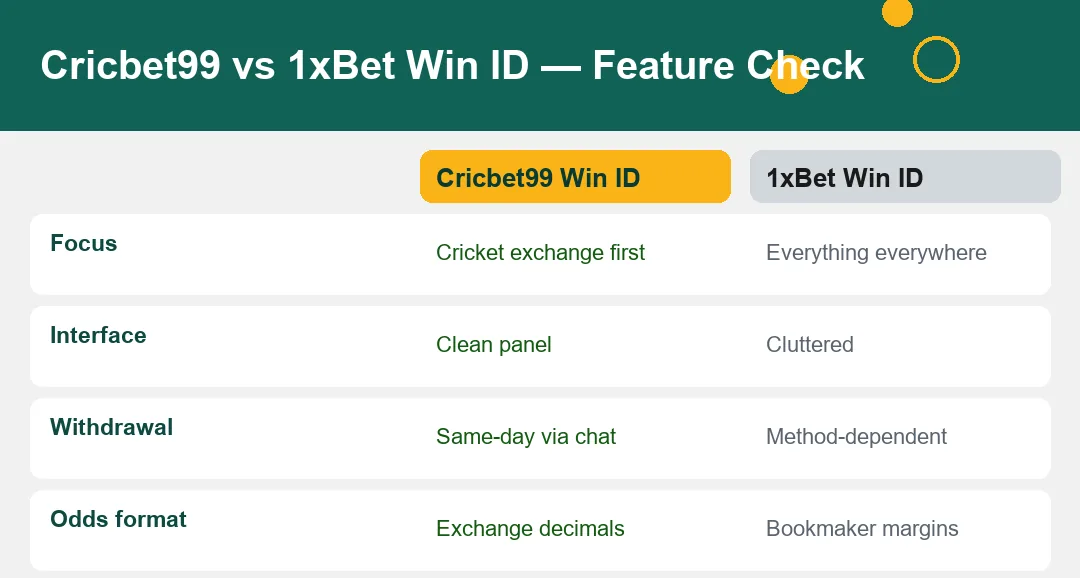
The most common complaint ex-1xBet players bring to our chat is payout friction: KYC requests surfacing at withdrawal time, method minimums, processing windows. To be fair, 1xBet pays — but the path can be long. The WhatsApp-ID model is structurally shorter: request in chat, verify settled balance, UPI the same day. Fewer moving parts, fewer surprises.
Walk the two paths on the same Sunday night, with 7,400 to take out. On the exchange side: you message the thread, the operator checks the settled balance against the bet log, confirms the UPI ID you always use, and the transfer lands inside the written window — one conversation, a record you keep. On the 1xBet side: you open the wallet, pick a withdrawal method from those currently available in your region, meet that method’s minimum, and — if it is your first payout or a large one — upload identity and address documents and wait for verification before the request even enters the processing queue. Then the wallet-to-bank leg runs on the method’s own timing.
None of that is dishonest. Document verification is what a licensed sportsbook’s model requires, and it buys a form of custody and recourse that the ID model does not offer. The point is that a player who values payout simplicity discovers the difference the first time they win meaningfully — the worst moment for a surprise — and a player who values regulated custody should choose 1xBet with eyes open rather than be talked out of it. The deposit guide covers the inbound leg of the same path on our side, where the contrast is smaller: gateways versus a UPI screenshot in chat.
Cricket markets on a real match night — the depth test
Take a Saturday IPL fixture rather than a hypothetical: Mumbai versus Chennai at the Wankhede, 7:30 start. On the exchange at the toss, Mumbai are 1.80 back and 1.82 lay, Chennai 2.20 and 2.24. The six-over session line sits at 55-56, the ten-over at 88-89, the innings total at 182-184, and the fancy board carries player runs for the top six, fall-of-first-wicket, highest over, and total boundaries. Every one of those lines has both a yes and a no price, which means every one can be traded, not just bet.
On 1xBet the same match shows a competitive match-winner price, an innings total, a top batter and top bowler market, some player props, and templated over-by-over markets that appear pre-match and thin out in-play. The market-depth verdict beside this section scores that gap wide, and the width is fair: a sportsbook’s cricket page is a product line; an exchange’s is the whole shop.
Where the depth test is kinder to 1xBet is outside cricket. Ask for corners in a Serie B match, map wins in a Counter-Strike qualifier, or a table-tennis line at 5 a.m., and the exchange has nothing while 1xBet has a price. That is real breadth and it deserves its bar on the chart. It just does not help you in the sixteenth over at Wankhede.
The practical test costs nothing: open both on the next big match and count the cricket markets with a live, tradeable second side. Our fancy guide explains what each line means so the count is informed rather than impressed.
Speed at every stage: signup, deposit, bet, settle, withdraw
1xBet has the faster front door and the exchange has the faster back door, and the honest speed comparison says both. Signup on 1xBet is genuinely one click — an account exists in seconds, with details and documents deferred. An exchange ID takes a two-minute WhatsApp exchange. Both are fast; 1xBet is faster by a minute, and that minute is worth naming because the "later KYC" row in the table is where the deferred time comes back.
The speed verdict beside this section is scored across the whole money loop, which is why it lands on the exchange side. Deposits: a UPI transfer confirmed in chat credits in minutes; a gateway deposit is usually as fast and occasionally bounced by gateway availability. Settlement: an exchange session posts as the over completes; a sportsbook settles markets at its own cadence, which for live props can lag. Withdrawal: same-day UPI in one thread versus a wallet queue with verification gates. The table under this section lays the stages out with typical timings on our side and honest ranges on theirs.
The caveat is the same one we give everywhere: speed is only worth paying for if you use it. A player who deposits monthly and withdraws twice a season will barely notice the back-door difference. A player who tops up between innings, or wants Sunday’s winnings out before Monday, notices every time.
| Stage | Cricbet99 Win ID | 1xBet |
|---|---|---|
| Account creation | 2-5 minutes on WhatsApp | Seconds (one-click), details later |
| Deposit to balance | UPI, confirmed in chat, minutes | Gateway, usually minutes, method-dependent |
| Live market settlement | Sessions post as the over completes | Book cadence, live props can lag |
| First withdrawal | Same day, written window | KYC upload, verification, then method timing |
| Exit a losing in-play position | Lay at your price, instantly if matched | Accept the house cash-out offer |
The numbers — one IPL season on each platform
Single-match comparisons understate the fee difference; a season exposes it. Take a player staking 1,000 per market across 60 IPL markets at fair 50/50 propositions, so roughly 30 winners. On 1xBet the bookmaker margin sits inside every price — on cricket match odds it is often modest, on props and templated live markets it is wider; call the blended figure 6-7%. That costs about 3,600 to 4,200 across the season regardless of results, paid silently on every bet. On the exchange, commission applies only to the 30 winning markets at 2-3% of net winnings — roughly 750 to 900.
Same bets, same results, same stake: a gap of around 3,000 produced purely by fee structure, which compounds every season you play. The stat verdict beside this section is drawn from that arithmetic, and you can reproduce it in five minutes with a calculator and both apps open — divide the bookmaker’s implied probabilities, sum them, and the overround is the margin.
Add the lay side and the gap widens in a way arithmetic alone cannot show. The exchange player who learns to lay off a winning position converts some losing nights into small locked profits, an option the 1xBet player never holds at any price. Sessions multiply it — sixty matches of over-by-over markets is not the same season as sixty match-winner bets.
Fairness cuts the other way on one line: 1xBet’s bonus calendar, used with discipline by a player who reads terms, can claw back part of that margin. It rarely claws back all of it, because wagering multiples steer bonus money through margined prices, but a serious accumulator player extracts real value from it and we would be lying to say otherwise. Our bankroll guide treats both margin and bonus turnover as cost lines for exactly this reason.
Bonuses and promotions, honestly compared
1xBet’s promotional machine is one of the largest in the industry: welcome packages, deposit matches, accumulator boosts, cashback loops, birthday tokens, a rotating calendar with the polish of a marketing department. The catch lives in the terms — wagering multiples on bonus funds, minimum-odds and minimum-selection rules that steer you into accumulators, expiry windows that reclaim what enthusiasm claimed. None of it is dishonest; all of it requires reading, and most players do not.
The Cricbet99-side offers are smaller and plainer: a welcome boost, weekly refills, referral rewards, quoted in your chat with percentage, minimum and turnover before you deposit, and documented in the thread forever. The effort-ratio test settles which model pays better for you: divide any bonus by its required turnover, then multiply by the margin or commission you will pay to complete that turnover. Run honestly, a 20% chat-quoted boost with a 3x turnover usually beats a 100% headline package with a 5x accumulator-only rollover — but a player who lives inside accumulator culture and enjoys the calendar as entertainment can genuinely come out ahead on 1xBet, and the effort-ratio test will tell them so.
Interface and daily experience — the part reviews skip
Feature tables miss how a platform feels at 10:45 p.m. in the sixteenth over. 1xBet’s apps are polished consumer software with a famous density problem: onboarding tours, promotional carousels, dozens of sports in the sidebar, a bet slip that congratulates you. It is pleasant in the way a large retail store is pleasant, and for occasional players that pleasantness is a real feature. Its cost is navigation — finding a specific cricket market means scrolling past merchandising, and in-play moments arrive through the app’s pace rather than the match’s. The native app also lives outside the Play Store on Android, which means sideloading an APK and updating it by hand.
The exchange panel is trading software wearing minimal clothes: the ladder, the session board, your positions, no carousel. First encounter reads as stark; first powerplay reads as fast. Prices update at ball speed, a bet is two taps, and the browser-panel model means nothing to install, nothing to update, no APK risk. Players who trade grow to love the starkness the way pilots love instrument panels — everything on screen earns its place.
Neither aesthetic is wrong; they are tuned for different sessions. The practical test is to watch one full T20 with each open. Where 1xBet feels complete for following the match, the panel feels necessary the moment you want to act on what the match is showing you — and that verb difference, following versus acting, is the interface comparison in one line. Our odds guide is the ten-minute read that turns the stark ladder into a familiar one.
Indian context: UPI, KYC, state law and the 18+ line
Both platforms serve Indian players, but they touch Indian infrastructure differently. On the exchange side, money moves by UPI to a detail supplied in chat, confirmed against your screenshot, and out by UPI to the ID you registered — no card, no wallet, no gateway. On 1xBet, deposits route through payment gateways and wallets, with method availability shifting from month to month, and withdrawals return through the same methods after verification. Both work; the exchange path has fewer intermediaries, the 1xBet path has more options on a good day and more surprises on a bad one.
The legal picture is shared. Online betting is a state-level grey area in India, several states restrict or prohibit real-money online gaming, and neither an international licence nor a WhatsApp ID changes what applies where you sit. Read the legality guide before choosing either. Both are strictly 18+; 1xBet enforces that with documents at withdrawal, the ID model enforces it with a human at signup, and both approaches are only as good as the enforcer.
- Lagana / khana
- Hindi for back and lay. 1xBet only offers lagana; the exchange offers both, which is why "khana" is the word that separates the two platforms.
- Margin / overround
- The bookmaker’s fee hidden inside its prices. Sum the implied probabilities of every outcome; the amount over 100% is what you pay per bet on 1xBet.
- Commission
- The exchange’s visible fee, charged on net winnings per market only. Losing bets pay nothing.
- KYC
- Know Your Customer — document verification of identity and address. Required by 1xBet’s model, typically at first or large withdrawal; not part of the ID model.
Where 1xBet honestly wins
Breadth, promos and one-click registration. If you bet on esports, table tennis at dawn, or want accumulator boosts across five sports, no exchange matches that range. Its app ecosystem and promo calendar are relentless. Players who treat betting as broad entertainment rather than cricket craft may find the catalogue worth the friction.
Add three more honest cases. Choose 1xBet if you specifically value document-verified custody and are willing to pay margin for it — that is a legitimate preference and the ID model cannot offer it. Choose it if you bet mostly football, where the exchange’s coverage is thin and 1xBet’s is encyclopaedic. And choose it if the casino is the main event: a hundred providers is a different scale of lobby from the complete-but-focused live suite on the exchange side.
Choose the Cricbet99 Win ID when cricket depth is the point: sessions, fancy, in-play trading in both directions, net pricing, and a service channel that answers at match speed. The overlap case exists: plenty of players keep a 1xBet account for football weekends and an exchange ID for cricket nights, and the two coexist happily in one betting life — provided each has its own written limit. The ID guide covers the two-minute setup on our side, and the provider rankings place both in the wider field.
Verdict
Cricket bettors: Cricbet99 Win ID — deeper cricket markets, cleaner interface, structurally faster payouts and the lay side. Catalogue explorers: 1xBet earns its place. The deciding heuristic: if 90% of your bets are cricket, choose the platform built 100% around it.
The longer version: the fee arithmetic alone — roughly 3,000 per 60-market season in favour of the exchange — would settle it for a weekly cricket bettor even if every other category tied. They do not tie. The lay side, the session board and the one-thread money path each add to the same side of the ledger, and the only category that pulls the other way with force is breadth, which cricket-first players do not spend.
Who should honestly choose the other side: multi-sport and esports players, football-first bettors, casino-main players who want a hundred providers, disciplined accumulator players who read bonus terms and profit from the calendar, and anyone who values KYC-backed custody enough to pay margin for it. These are real players, well served on 1xBet, and this page would be less believable if it pretended otherwise.
Whichever side you choose, the protective rules are identical: read the withdrawal terms before the first deposit, run a small round trip before a large one, fix a per-match limit, and keep the responsible-gambling page bookmarked before the season starts.
More head-to-heads live in the guides library, or start from the main Cricbet99 Win ID page. Ready to try the Cricbet99 side of the table? Registration takes two minutes.